Disclaimer! This isn’t sponsored. It’s not an ad. There are plenty of other tools you can use to help you plan your book. I just happened to use Milanote for mine so that’s what I’m going to talk about here.
Right, now that’s out of the way, let’s get down to business. When it comes to writing, I’m a Planner. Always have been, always will be. I wouldn’t dream of trying to be a Pantser. I have much admiration for people who are, but me? I need to have everything planned out in detail before I even think of drafting.
Over the years, I’ve used various tools to do this; notes in notebooks, drawing pictures of my characters (and I cannot draw), sticky notes on walls, Word, Excel, Pinterest. But for my most current book “Away, Behind”, I ended up using an online tool called “Milanote“.
What is Milanote?
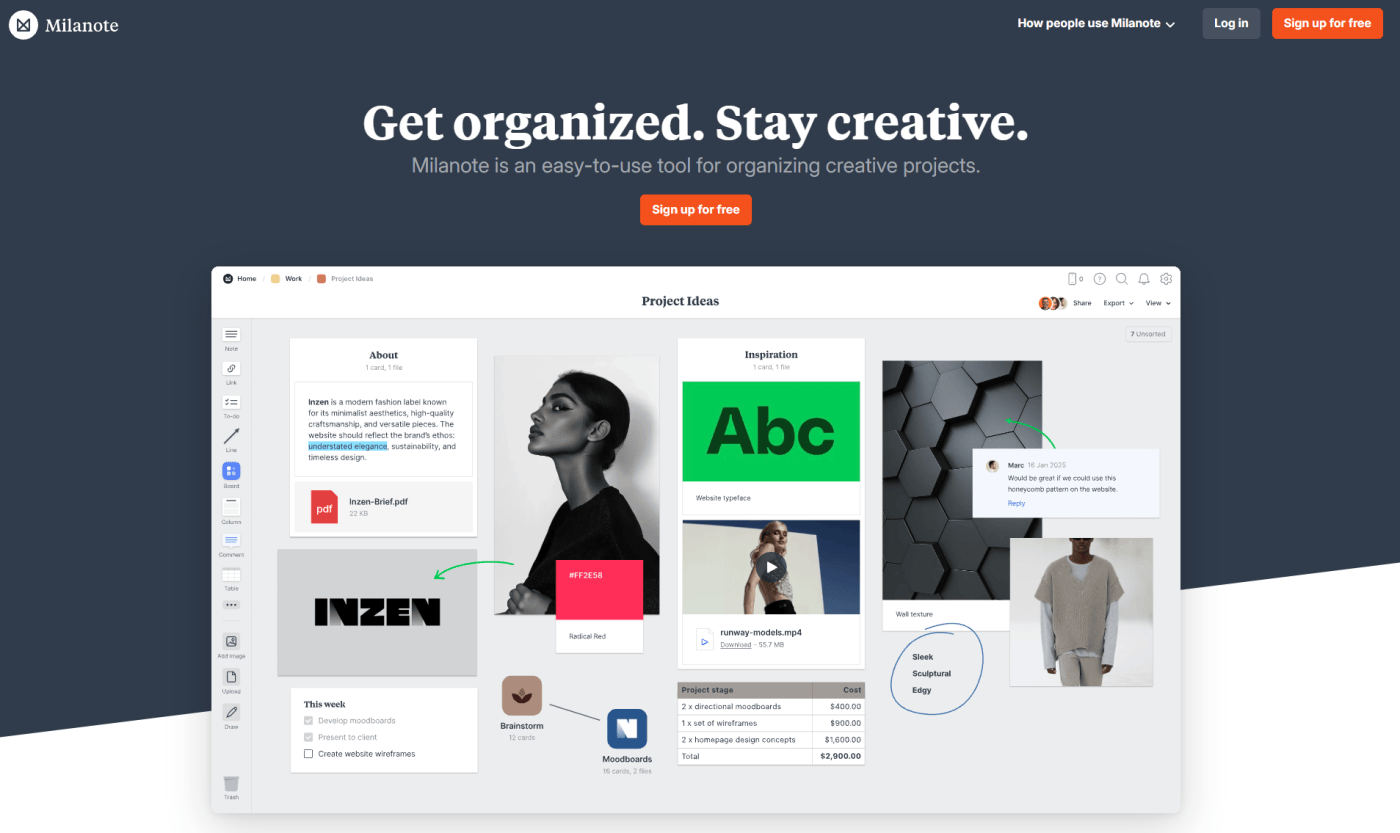
Essentially Milanote is an online creative planner/moodboard. There are ready-made boards and cards to use, plus you can upload images, videos, links, notes, tables, maps – basically any kind of element to bring your project to life. You can share it with others if you need to be collaborative.
It has pre-built templates for various project ideas including writing a novel if you need some guidance, or you can go freestyle. I checked out the one for writing a book when I first started and found some useful ideas there, although I didn’t use all the suggestions.
How I used the tool
I currently use the tool for both planning this book and keep track of writing competitions. So I created a “board” for my book, has three sub-boards, that also have sub-boards. You can kind of go as deep as you need to. The three top boards are “Inspiration”, “Structure” and “Characters” so pretty straightforward.
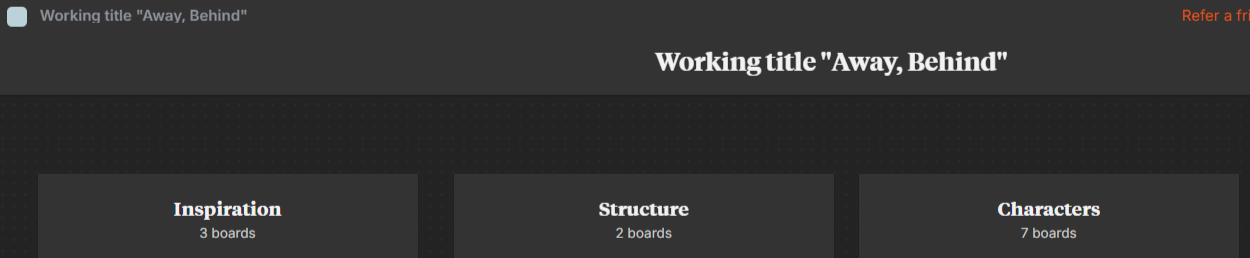
Under “Inspiration”, I have three more boards – “Research”, “Moodboard” and “World Building”. “Research” is self-explanatory, “Moodboard” is purely thematic imagery whereas “World building” has a much more specific mixture of content to flesh things out.
“Characters” as you might expect, consists of a character breakdown card for each one, with biographical details, pictures, backstory, arc notes and really anything I care to put in there.
And lastly “Structure”. This includes an outline board with notable events for each of my three timelines and a detailed plot breakdown. This is basically a table, but it includes links to the characters, colour-coding, scene breakdowns etc. Like anything, when I started writing things changed somewhat, but this really helped me to not get caught up with the plot when I was initially drafting each scene.
What I liked
Developing my book this way felt easy and intuitive. There were plenty of options on layouts and I could add whatever assets I needed to. It’s easy to switch between boards and cards, and link things together rather than flick between documents or have lots of files open.
What I didn’t like
The free version only allows you to have 100 assets, whereas with the paid versions you get an unlimited amount. I planned everything using the paid version but now I’m back to the free version, I have too many assets and can’t add anything further. I will say they haven’t forced me to remove anything either, so I guess that’s a bonus!
Which brings me to the price. It’s $9.99 a month (roughly £7.50 at the time of writing) if you pay annually, or $12.50 (about £9.40) a month if you pay monthly. I checked and it was the same when I had the paid version in 24/25 so it hasn’t gone up – yet. It is quite a bit especially for a subscription based tool. A piece of software you buy outright may be a bigger chunk of change, but at least it’s all yours and the fees won’t move.
Would I use it again?
In general I think this is a good basic option for book planning but whether I use it again, really depends on whether I’d consider going for the paid version. I think for a lot of people’s needs – if you were planning a series for example – you’d need the paid version. And that might not be something you can justify spending your moolah on. So I’d probably scout out different options. Still, for a free option, it’s been good. If you’re interested in getting Milanote, I have a referral link, whereby a sign-up gets me some extra cards if you’re feeling altruistic!
Enjoyed this post?
If you’d like to support the blog, you can leave a small tip. It helps me keep writing about books, writing and literary places.
Related reading
If you’re after more writing advice, I recommend On Writing: A Memoir of the Craft by Stephen King. Or the classic The Elements of Style by William Strunk Jr and E.B. White.
Some of these are affiliate links, which means I may earn a small commission if you buy through them, at no extra cost to you.


Leave a Reply